
This post may contain affiliate links, which means I may receive a commission for purchases made through the links. I will only recommend products that I have personally used! Learn more on my Disclosure page!
Ever stared at your houseboat insurance bill like it’s written in ancient hieroglyphs? You’re not alone. Picture this: Your marina neighbor brags about paying less than their Netflix subscription, while your premium feels closer to a car payment—and nobody can tell you why. It’s like insurers have a secret recipe involving your zodiac sign and how many seagulls perch on your roof. But here’s the kicker—decoding this isn’t just about pinching pennies. That policy? It’s the invisible rope keeping your floating haven from drifting into financial disaster when storms hit or parties get rowdy. Think of it as buying silence—the kind where you sleep through midnight thunderstorms knowing if your kitchen sinks, you won’t. Welcome to our Houseboat Insurance Cost guide!
The Unique Nature of Houseboat Insurance Pricing
Buying insurance for your houseboat is like ordering a cocktail from a bartender who’s never heard of a menu. You thought it’d be simple—after all, you insure your house, you insure your car. But this? It’s a Frankenstein policy stitched together from boat parts and home insurance scraps. Picture trying to explain to your insurer that your “living room” might literally float away during a storm, or that your “driveway” has tides and jellyfish.
Insurers squint at houseboats like they’re alien artifacts. That cozy bedroom nook? To them, it’s a flood risk waiting to happen. The charming dock you tied up to? A lawsuit magnet if someone trips after too many sunset margaritas. While your land house worries about burglars and kitchen fires, your floating pad battles submerged logs, marina fender-benders, and the existential threat of becoming an accidental submarine.
Here’s the kicker: Your neighbor’s nearly identical houseboat could cost half as much to insure. Why? Maybe they dock in a no-wake zone you’ve never heard of. Maybe their “vintage” 1990s plumbing scares underwriters less than your shiny new (but untested) eco-friendly system. Or maybe they lied about how often their college kids “borrow” the boat for “study weekends.” Point is, insurers treat houseboats like snowflakes—no two risk profiles melt the same way.
So when they ask for your “vessel’s propulsion type” and “average days occupied monthly,” they’re not just being nosy. They’re trying to decide if you’re a responsible mermaid or a disaster-prone pirate. Your answers could mean the difference between “affordable premium” and “sell a kidney.” Pro tip: That “occasional recreational use” fib? The claims adjuster will notice the TikTok of your Fourth of July houseboat rave.
Primary Factors That Determine Your Houseboat Insurance Cost

The seemingly mysterious numbers on your insurance quote actually stem from a complex calculation involving numerous variables. Understanding these factors not only demystifies your premium but potentially helps you identify opportunities to reduce it.
Houseboat Value, Age, and Condition: The Foundation of Your Premium
Just as with automobiles, your houseboat’s value significantly impacts insurance costs. Higher-value vessels simply cost more to repair or replace, driving premium increases. A luxury $500,000 houseboat might command annual premiums between $3,000-$7,000, while a modest $50,000 vessel might cost just $800-$1,500 to insure.
Age plays a crucial role too, but perhaps not how you’d expect. While older houseboats generally have lower market values (potentially reducing premiums), they often present higher risk factors due to aging systems, outdated construction methods, and accumulated wear. Some insurers even decline coverage for houseboats beyond a certain age without extensive documentation and inspections.
Condition matters tremendously, with well-maintained vessels qualifying for significantly lower rates. Insurance companies love seeing regular maintenance records, professional inspections, and updated systems—all signals that you’re a responsible owner who minimizes preventable risks.
Size and Type: Dimensions of Risk
Size matters in houseboat insurance, with larger vessels generally commanding higher premiums. This correlation exists not just because bigger houseboats cost more, but because they present increased operational challenges, greater potential for damage, and higher liability exposure.
The type of houseboat significantly influences costs as well:
- Trailerable houseboats typically enjoy lower premiums due to their ability to be removed from water during severe weather or off-seasons.
- Cruising houseboats with substantial navigational capabilities face moderate premiums reflecting their mobility and construction.
- Floating home-style houseboats with limited propulsion might see lower navigational risk but higher structural coverage costs.
- Custom-built houseboats often face premium surcharges until they establish proven performance records.
Construction Materials and Build Quality: The Structural Impact
Insurance companies scrutinize construction materials closely, with premiums reflecting durability and repair costs. Aluminum hulls might reduce premiums due to corrosion resistance and repairability, while fiberglass structures might increase costs due to specialized repair requirements.
Build quality extends beyond materials to design integrity. Houseboats built by recognized manufacturers with strong safety records typically command lower premiums than those from lesser-known builders or DIY projects. Some insurers even maintain “approved builder” lists that affect eligibility and pricing.
Navigation Area and Storage Location: Geography Matters
Where you operate and store your houseboat dramatically impacts insurance costs. Vessels in hurricane-prone coastal waters face substantially higher premiums—sometimes 30-50% more—than those on protected inland lakes.
Even on the same body of water, specific storage arrangements influence pricing:
- Protected marina slips with security features typically earn discounts
- Exposed mooring locations may increase premiums due to weather vulnerability
- Seasonal storage arrangements (like winter dry-docking) can reduce annual costs
- Hurricane preparation plans can qualify coastal vessels for significant discounts
Primary Residence vs. Vacation Property: Usage Patterns
Do you live aboard your houseboat full-time or use it occasionally for vacations? This distinction significantly impacts insurance costs, with full-time residency typically increasing premiums by 15-30%.
This differential reflects several realities: live-aboard vessels experience more continuous wear, contain more personal property, and present greater liability exposure. However, some specialized insurers offer competitive live-aboard policies that recognize the increased oversight and maintenance that full-time residents typically provide.
Owner Experience and Boating History: The Human Factor
You—the owner and operator—represent perhaps the most significant risk factor in the insurance equation. Experienced houseboat owners with clean boating records can enjoy substantially lower premiums than novices or those with previous claims or violations.
Many insurers offer significant discounts—often 10-20%—for completing recognized boating safety courses. These educational investments quickly pay for themselves through premium reductions while making you a safer, more confident operator.
How Your Usage Affects Insurance Costs
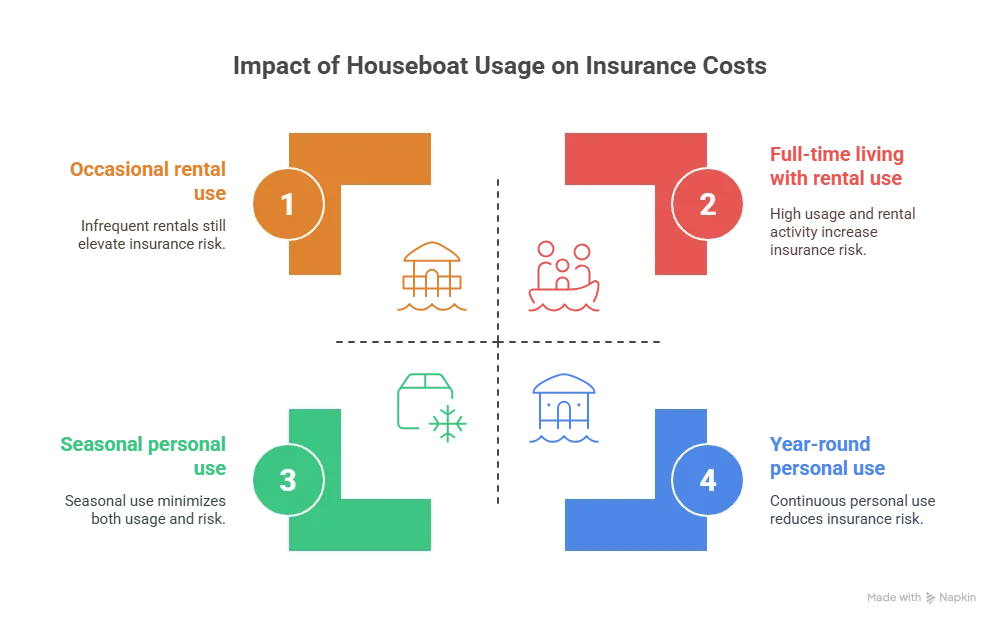
Beyond the physical characteristics of your houseboat, how you use it dramatically impacts insurance pricing. These usage factors often provide the greatest opportunities for customizing coverage and controlling costs.
Full-time Living vs. Occasional Use: Residence Patterns
Full-time living naturally increases exposure to risks simply through continuous occupation. However, it’s not all negative from an insurance perspective. Live-aboard owners typically provide better oversight, notice problems earlier, and maintain systems more diligently than occasional users.
Some specialized insurers recognize these offsetting factors, offering competitive live-aboard policies that don’t excessively penalize full-time residence. These policies typically include enhanced personal property coverage reflecting the greater amount of belongings stored onboard.
Rental to Others vs. Personal Use Only: The Commercial Factor
Do you occasionally rent your houseboat to others? This commercial usage dramatically impacts insurance costs, often requiring specialized coverage beyond standard policies. Rental use typically increases premiums by 25-50% due to the heightened risks associated with less experienced operators and potentially less careful usage.
Some insurers refuse to cover rental scenarios altogether, while others offer specific endorsements designed for occasional rentals. These endorsements typically specify rental frequency limitations and may require professional management of the rental process.
Navigational Patterns and Cruising Range: Movement Metrics
How far and how often you travel in your houseboat significantly impacts insurance costs. Vessels that remain primarily stationary at protected moorings typically enjoy lower premiums than those regularly navigating open waters.
Insurance policies typically specify navigational limits—geographic boundaries within which your coverage remains valid. Expanding these limits generally increases premiums, reflecting the greater exposure to varying conditions and hazards.
Seasonal vs. Year-Round Usage: Calendar Considerations
Many houseboat owners use their vessels seasonally, particularly in northern climates where winter conditions make operation impractical. This usage pattern can significantly reduce insurance costs through “lay-up periods”—designated timeframes when the vessel remains unused and secured.
During these periods, certain coverage elements may be suspended or reduced, lowering premiums accordingly. Some policies offer premium reductions of 10-30% for vessels with substantial seasonal lay-up periods, particularly when stored in secure facilities.
Average Cost Ranges for Houseboat Insurance

While every houseboat insurance policy is unique, understanding typical premium ranges helps establish realistic expectations and budgeting parameters. These ranges reflect standard coverage with typical deductibles for vessels in average condition with experienced owners.
Typical Annual Premium Ranges for Different Houseboat Types
- Small trailerable houseboats ($30,000-$75,000 value): $500-$1,200 annually
- Mid-size cruising houseboats ($75,000-$200,000 value): $1,200-$3,000 annually
- Large luxury houseboats ($200,000-$500,000 value): $3,000-$7,500 annually
- Floating home-style houseboats (stationary with limited propulsion): $1,500-$4,000 annually
These figures assume standard liability limits ($300,000-$500,000), typical deductibles ($1,000-$2,500), and operation in moderate-risk waters. Adjusting any of these variables naturally affects premium costs.
Cost Comparison: Small vs. Large Houseboats
Size impacts insurance costs both directly and indirectly. Larger houseboats not only represent greater asset value but typically feature more complex systems, higher horsepower engines, and greater potential liability exposure.
The relationship isn’t strictly linear, however. A 50-foot houseboat doesn’t necessarily cost twice as much to insure as a 25-foot vessel. Insurance actuaries consider numerous factors beyond simple dimensions, including design sophistication, construction quality, and safety features that may partially offset size-related risks.
Cost Comparison: Older vs. Newer Models
Age affects houseboat insurance costs in complex ways. Newer vessels typically command higher premiums simply because their replacement value exceeds older models. However, this higher valuation may be partially offset by modern safety features, updated construction standards, and manufacturer warranties that reduce certain risks.
Older houseboats, while lower in market value, often face age-related surcharges or coverage limitations. Vessels over 15-20 years old typically require more detailed surveys and may face restrictions on certain coverage elements unless extensively refurbished or upgraded.
Regional Cost Variations Across the United States
Geography dramatically impacts houseboat insurance costs, with regional variations reflecting both environmental hazards and regulatory environments:
- Coastal regions (particularly Florida, Gulf Coast, and hurricane-prone areas): Premiums 30-50% higher than national averages
- Great Lakes region: Moderate premiums with seasonal adjustments for winter conditions
- Inland lakes in temperate zones: Typically the most affordable insurance regions
- Western reservoirs (Lake Powell, Lake Mead): Moderate premiums reflecting remote locations but stable weather patterns
These regional variations explain why identical houseboats might face substantially different insurance costs based solely on their primary operating location.
Coverage Options That Impact Your Premium

The coverage choices you make significantly influence your premium costs. Understanding these options helps you balance protection against budget considerations.
Liability Coverage Limits: Protection Parameters
Liability coverage protects you when you’re responsible for injuries to others or damage to their property. Standard policies typically offer $300,000 in liability protection, but increasing these limits often represents an insurance bargain.
For example, increasing liability coverage from $300,000 to $1 million might add just $100-$300 to annual premiums while providing substantially greater protection against catastrophic claims. Given today’s medical costs and litigation environment, many insurance professionals recommend liability limits of at least $500,000 for most houseboat owners.
Actual Cash Value vs. Agreed Value Policies: Valuation Variables
The valuation method in your policy dramatically impacts both premiums and potential claim payments:
- Actual Cash Value (ACV) policies consider depreciation when calculating claim payments. While these policies offer lower premiums, they may leave significant gaps between claim payments and replacement costs, particularly for older vessels.
- Agreed Value policies predetermine the vessel’s value when the policy is written. This agreed-upon value becomes the basis for total loss claims, regardless of depreciation. While these policies command higher premiums (typically 15-30% more than ACV), they provide superior financial protection and greater certainty about claim payments.
The premium difference between these options increases with vessel age, as depreciation becomes a more significant factor in older houseboats.
Deductible Options: Financial First Response
Your deductible—the amount you pay before insurance coverage activates—directly impacts premium costs. Higher deductibles naturally reduce premiums, but increase your out-of-pocket expenses when filing claims.
Typical houseboat insurance deductibles range from $1,000 to $5,000, with premium discounts of approximately 8-12% for each $1,000 increase in deductible. This relationship makes higher deductibles particularly attractive for experienced owners with adequate emergency savings and vessels in excellent condition.
Optional Coverages and Their Additional Costs
Beyond standard protection, numerous optional coverages allow policy customization—each adding incremental costs:
- Personal effects coverage: Protects belongings stored aboard ($100-$300 annually for $20,000 coverage)
- Emergency assistance: Provides towing and on-water support ($75-$200 annually)
- Machinery damage: Extends protection to mechanical breakdowns beyond standard coverage ($200-$500 annually)
- Consequential damage: Covers losses resulting from wear and tear (typically 5-10% premium increase)
- Fishing equipment coverage: Specialized protection for anglers ($50-$150 annually)
- Vacation liability extension: Expands protection when docked at vacation spots ($75-$200 annually)
These options allow precise tailoring of coverage to your specific usage patterns and risk tolerance, though each naturally increases premium costs.
Hidden Costs and Fees to Consider
Beyond the quoted premium, several additional expenses affect the true cost of houseboat insurance. Understanding these potential add-ons helps avoid budget surprises.
Survey and Inspection Requirements: Professional Assessment
Many insurers require professional marine surveys before issuing coverage, particularly for older houseboats or high-value vessels. These detailed inspections assess your houseboat’s condition, systems, and compliance with safety standards.
Survey costs typically range from $20-$25 per foot of vessel length, meaning a 40-foot houseboat might require an $800-$1,000 survey. While representing a significant upfront expense, these assessments often identify issues that, when addressed, can reduce long-term premium costs while improving vessel safety and reliability.
Documentation and Registration Fees: Paperwork Expenses
Proper documentation remains essential for insurance coverage, with costs varying by state and vessel characteristics. Registration fees typically range from $25 to several hundred dollars annually, depending on vessel size and value.
Some states impose additional taxes or fees on houseboats used as primary residences, potentially adding hundreds or thousands to annual ownership costs. These expenses, while not directly part of insurance premiums, represent required expenditures for maintaining proper coverage.
Policy Fees and Payment Plan Charges: Administrative Add-ons
Many insurers assess policy fees beyond the base premium, including:
- New policy initiation fees: One-time charges of $25-$100 when establishing coverage
- Installment plan fees: Surcharges for monthly or quarterly payment options ($3-$10 per payment)
- Documentation fees: Charges for policy document production and delivery ($10-$30)
- Endorsement fees: Costs for mid-term policy modifications ($25-$50 per change)
These seemingly minor charges can add 5-10% to your effective insurance costs, making annual payment options and electronic document delivery worthwhile considerations for cost-conscious owners.
Claims History Impact on Future Premiums: The Long-Term Effect
Perhaps the most significant hidden cost involves premium increases following claims. Filing a claim typically results in premium surcharges for 3-5 years, with increases ranging from 10% for minor claims to 50% or more for significant losses or liability incidents.
This long-term impact explains why many experienced houseboat owners choose to self-fund minor repairs rather than filing claims, reserving their insurance for truly significant losses that exceed their financial capacity to absorb.
Ways to Lower Your Houseboat Insurance Costs

Despite the complex factors affecting houseboat insurance pricing, numerous strategies can help reduce premiums without sacrificing essential protection.
Safety Equipment Discounts: Protection Pays Off
Most insurers offer premium discounts for approved safety equipment, including:
- Fire extinguishing systems: Automatic systems can earn 5-10% discounts
- Carbon monoxide and smoke detectors: Typically worth 2-5% premium reductions
- Emergency position indicating radio beacons (EPIRBs): Can reduce premiums 3-7%
- Burglar alarms and security systems: May qualify for 5-10% theft protection discounts
These investments improve both safety and affordability—a rare win-win in the insurance world. Many safety improvements pay for themselves within 2-3 years through premium reductions while providing invaluable protection.
Boating Education and Certification Discounts: Knowledge Rewards
Completing recognized boating safety courses often qualifies for substantial premium discounts, typically 5-15%. These educational programs enhance your skills while demonstrating responsibility to insurers.
Particularly valuable certifications include:
- U.S. Coast Guard Auxiliary Boating Safety Course
- U.S. Power Squadrons Boat Handling Course
- State-specific boater education certificates
- Professional captain’s licenses for larger vessels
These credentials not only reduce premiums but make you a safer, more confident operator—benefits that extend far beyond insurance considerations.
Multi-Policy and Loyalty Discounts: Relationship Rewards
Many insurance companies offer multi-policy discounts when you bundle houseboat coverage with auto, home, or other insurance products. These loyalty discounts can significantly reduce overall insurance costs while simplifying your financial management.
Typical bundling discounts range from 10-20%, making this strategy particularly effective for comprehensive cost management across your insurance portfolio. Long-term relationships with insurers often qualify for additional loyalty discounts, typically 5% after three years and increasing thereafter.
Seasonal Layup Credits: Calendar-Based Savings
If you use your houseboat seasonally, substantial premium reductions may be available through “lay-up periods”—designated timeframes when the vessel remains unused and secured. During these periods, certain coverage elements may be suspended or reduced, lowering premiums accordingly.
Some policies offer premium reductions of 10-30% for vessels with substantial seasonal lay-up periods, particularly when stored in secure facilities. These arrangements require strict adherence to specified storage protocols and usage restrictions during the lay-up period.
Claims-Free Discounts: History Rewards
Maintaining a claims-free record typically qualifies for significant premium discounts, often increasing with each consecutive year without claims. These discounts commonly start at 5% after one claims-free year and may reach 20-25% after five consecutive years without claims.
This progressive reward system explains why many experienced houseboat owners choose to self-fund minor repairs rather than filing claims, preserving their claims-free status for maximum long-term savings.
Insurance Cost Considerations for Different Houseboat Types
Different houseboat categories present unique insurance considerations and cost structures. Understanding these variations helps identify the most cost-effective options for your specific situation.
Trailerable Houseboats: Mobility Advantages
Smaller houseboats that can be transported on trailers typically enjoy several insurance advantages:
- Storm avoidance capability: The ability to remove the vessel from water during severe weather often reduces premiums by 10-20% in hurricane-prone regions
- Storage flexibility: Options for secure off-water storage during non-use periods
- Geographic adaptability: Ability to operate in different waterways without permanent navigational restrictions
These advantages typically translate to lower base premiums, though trailerable houseboats may face higher per-foot costs due to their typically simpler construction and lower overall values.
Cruising Houseboats: Mobile Considerations
Houseboats designed for extended cruising present moderate insurance costs reflecting their mobility and construction quality. Their insurance considerations include:
- Navigational range: Broader cruising areas typically increase premiums
- Systems complexity: More sophisticated navigation and operational systems may increase repair costs
- Usage patterns: Typically higher engine hours and operational time than stationary vessels
Insurance for these vessels often includes specialized coverage for mechanical systems and navigational equipment, reflecting their crucial role in safe operation during extended journeys.
Floating Home-Style Houseboats: Stationary Factors
Houseboats designed primarily as floating residences with limited propulsion capabilities present unique insurance considerations:
- Reduced navigational risk: Limited movement capability may reduce certain premium components
- Increased structural coverage: Greater emphasis on dwelling aspects of coverage
- Mooring security: Heightened importance of secure docking arrangements
- Utility connections: Additional considerations for shore power, water, and waste systems
These vessels often benefit from specialized policies that recognize their hybrid nature, with premiums reflecting their reduced mobility but increased residential characteristics.
Custom-Built Houseboats: Uniqueness Premium
Custom-built houseboats typically face premium surcharges until they establish proven performance records. These unique vessels present several insurance challenges:
- Valuation complexity: Difficulty establishing replacement costs for one-of-a-kind designs
- Construction variability: Uncertainty about building methods and materials
- Performance history: Limited data on long-term reliability and safety
Insurers typically address these uncertainties through higher initial premiums, detailed surveys, and possibly coverage limitations until the vessel establishes a performance history. These premiums often decrease after several years of claims-free operation.
Real-World Cost Examples: Houseboat Insurance Cost
Abstract premium ranges gain meaning through concrete examples. These case studies illustrate how various factors combine to determine actual insurance costs for different houseboat scenarios.
Case Study: Insurance Cost for a 40-foot Older Houseboat
Consider a 20-year-old 40-foot Gibson houseboat valued at $85,000, operated seasonally on an inland lake in Tennessee:
- Base premium: $1,400 annually for $85,000 Actual Cash Value coverage
- Liability coverage: $300,000 included in base premium
- Deductible: $1,000 standard
- Adjustments:
- +$200 for vessel age (20 years old)
- -$140 for seasonal use (laid up 4 months annually)
- -$210 for safety equipment and boating education certification
- -$125 for multi-policy discount with auto insurance
- Final annual premium: $1,125
This example illustrates how various discounts can offset age-related surcharges, resulting in reasonable coverage costs even for older vessels.
Case Study: Insurance Cost for a New Luxury Houseboat
Now consider a new 75-foot luxury houseboat valued at $450,000, used as a vacation property on Lake Powell:
- Base premium: $5,400 annually for $450,000 Agreed Value coverage
- Liability coverage: $1,000,000 included in base premium
- Deductible: $2,500 standard
- Adjustments:
- -$540 for new vessel discount
- -$270 for security system and advanced safety equipment
- -$810 for professional captain operation during movement
- +$675 for extended navigational range throughout Lake Powell
- Final annual premium: $4,455
This example demonstrates how even expensive vessels can achieve reasonable insurance rates through appropriate risk management strategies and security measures.
Case Study: Insurance Cost for a Floating Home-Style Houseboat
Finally, consider a 10-year-old 50-foot floating home-style houseboat valued at $175,000, permanently moored in Seattle and used as a primary residence:
- Base premium: $2,100 annually for $175,000 Agreed Value coverage
- Liability coverage: $500,000 included in base premium
- Deductible: $1,500 standard
- Adjustments:
- -$315 for limited navigation (permanently moored)
- +$525 for full-time live-aboard use
- -$210 for marina security features
- -$315 for claims-free history (5+ years)
- Final annual premium: $1,785
This example illustrates how reduced navigational risk can offset live-aboard surcharges, resulting in reasonable premiums even for primary residence vessels.
The Peace of Mind Premium: Why Proper Coverage Matters
When evaluating houseboat insurance costs, remember that premiums represent more than just another expense—they’re investments in security and peace of mind. Comprehensive coverage protects not only your valuable asset but also your financial future against potentially catastrophic liabilities.
The true value of proper insurance becomes apparent only when disaster strikes. At that critical moment, the difference between adequate coverage and cutting corners can mean the difference between a manageable inconvenience and financial devastation.
Consider this perspective: annual insurance premiums typically represent just 1-2% of your houseboat’s value—a modest investment to protect both the vessel itself and your broader financial security. When viewed through this lens, quality coverage becomes not an optional luxury but an essential component of responsible houseboat ownership.
Conclusion: Houseboat Insurance Cost
Understanding the complexities of houseboat insurance costs is just the first step. To get a clearer picture of what protection might cost for your specific situation, use our free houseboat insurance calculator. This powerful tool provides personalized estimates based on your houseboat’s characteristics, location, and usage patterns.
Don’t leave your floating investment vulnerable to the unpredictable nature of life on water. Explore your coverage options today and secure the protection your houseboat deserves.